

Permit Applications for Roadworks in Queensland.
Before any works affecting a roaad corridor can commence in Queensland, contractors are required to obtain approval from the relevant authority. This process involves submitting a permit application supported by compliant Traffic Management Plans (TMPs) and Traffic Guidance Schemes (TGS).
Which Projects Need Permits and Approval?
Depending on the scope and location of the works, permits may need to be approved by:

Department of Transport and Main Roads (TMR)
For works conducted on or near state-controlled roads, permits must be obtained from the Department of Transport and Main Roads (TMR). This ensures that all activities meet state regulations governing traffic management, road safety, and infrastructure protection. TMR approval is particularly important for projects involving lane closures, temporary traffic diversions, or activities that may impact traffic flow on major routes. Early engagement with TMR helps streamline approval processes and ensures compliance with state legislation and technical standards.

Local Council
When works occur on council-managed roads, verges, or footpaths, approval from the relevant local council is typically required. Councils oversee public safety, access, and amenity within their jurisdictions, so their permits confirm that construction, maintenance, or excavation activities align with local laws and infrastructure requirements. This may include traffic management plans, reinstatement standards, and noise or timing restrictions to minimise disruption to the community and surrounding businesses.

Other Stakeholders
Depending on the location and potential impacts of the works, additional permits or notifications may be required from other stakeholders such as the Queensland Police Service, public transport operators, or utility providers. Police involvement may be necessary for complex traffic control operations or high-risk environments, while coordination with transport authorities ensures minimal disruption to bus or rail services. Similarly, engaging with utility providers helps prevent service interruptions and protects underground or overhead assets like water, gas, and power lines.
Roadwork Standards and Requirements.
Permit applications must align with the following Queensland standards and legislation:
MUTCD Part 3 – Works on Roads (QLD).
This document provides the primary technical requirements for designing and implementing temporary traffic management on Queensland roads. It outlines the standards for signage, delineation, and safety measures to ensure that road users and workers are adequately protected during works. Compliance with MUTCD Part 3 is mandatory for all activities affecting traffic flow, including lane closures, shoulder works, and roadside operations.
Traffic Management for Works on Roads Code of Practice 2021 (TM-CoP).
The TM-CoP sets out practical guidance on meeting legislative obligations under the Work Health and Safety Act in relation to traffic management. It details responsibilities for persons conducting a business or undertaking (PCBUs), requirements for Traffic Management Plans (TMPs) and Traffic Guidance Schemes (TGSs), and protocols for risk assessment and site supervision. Following the Code ensures best practice in worker safety and public protection across all road environments.
Austroads Guide to Temporary Traffic Management (AGTTM).
The AGTTM provides a nationally consistent framework for planning, design, and implementation of temporary traffic management across Australia and New Zealand. It includes principles for risk-based design, selection of appropriate controls, and performance-based outcomes. While Queensland has adapted this guide to align with local conditions, adherence to AGTTM principles supports uniformity and professionalism across projects involving road and infrastructure works.
Work Health & Safety Act 2011 (Qld).
This legislation establishes the legal duties for ensuring the health and safety of workers and the public during all phases of roadwork operations. Under the Act, PCBUs must identify hazards, manage risks, and maintain safe systems of work, including those related to vehicle movements, plant operation, and work zone access. Compliance is enforced by Workplace Health and Safety Queensland, with penalties for breaches that compromise safety.
Any Additional Council-Specific Requirements.
Individual councils may impose supplementary requirements to address local conditions, infrastructure sensitivities, and community expectations. These may include additional permit conditions, specific reinstatement standards, working-hour restrictions, or environmental protections. Understanding and adhering to these local provisions is essential to ensure smooth project approvals and maintain compliance with all governing authorities.
Non-compliant submissions risk rejection, project delays, and potential fines.
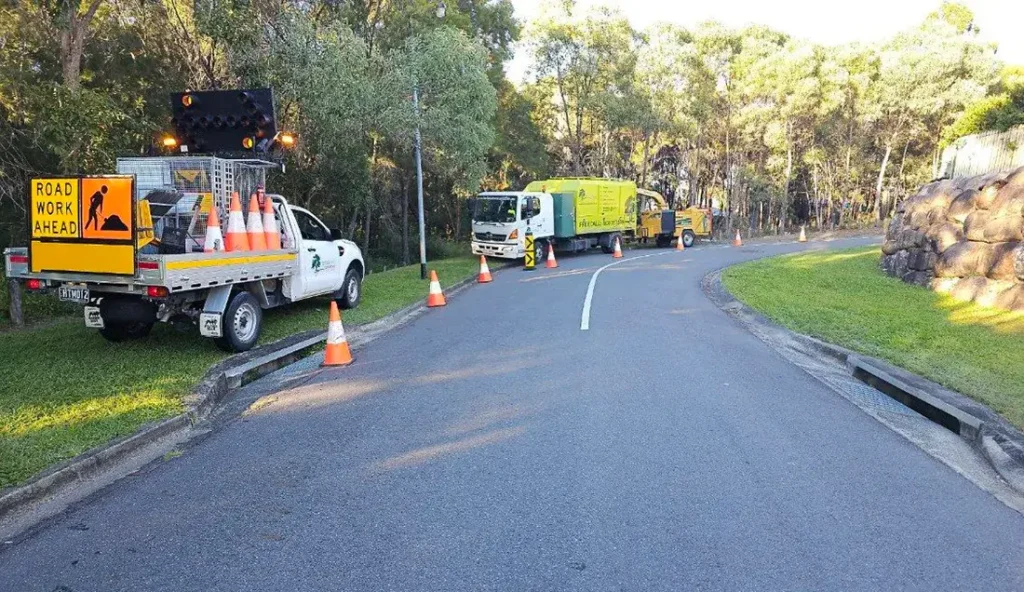

What’s Included in a Permit Application
A complete permit submission generally requires:
- Completed application form (council or TMR-specific).
- Traffic Management Plan (TMP): outlining risk management, responsibilities, and compliance.
- Traffic Guidance Scheme (TGS): showing detailed site layouts, signage, and staging.
- Public liability insurance details (usually minimum $20 million cover).
- Evidence of accreditation: including the Traffic Management Designer’s registration with TMR.
- Supporting documents: such as notifications to emergency services, affected residents, or public transport operators if required.
Submission Process
The permit application process in Queensland typically follows these steps:
- Pre-Planning: Identify road authority and permit requirements.
- Design: Develop TMPs and TGS in compliance with MUTCD Part 3 and AGTTM.
- Application Submission: Lodge forms and supporting documents with the authority (e.g., via TMR’s Road Corridor Permit System (RCPS) or council e-portals).
- Review and Assessment: Authorities assess compliance, risk mitigation, and community impacts.
- Approval and Conditions: Permits are issued with conditions that must be followed on-site.
- Implementation and Monitoring: Approved TMP and TGS are executed by accredited traffic controllers.
Processing times vary depending on the authority and project complexity. TMR applications for state-controlled roads often require a minimum of 10 business days for review.
Common Types of Permits
In Queensland, common permit applications include:
Road Corridor Permits for Works on State-Controlled Roads.
These permits are issued by the Department of Transport and Main Roads (TMR) to authorise activities within or adjacent to the road corridor of a state-controlled road. They cover a wide range of works, including excavation, maintenance, and installation of utilities, ensuring such activities do not damage road assets or disrupt the safe flow of traffic. Applicants must provide detailed Traffic Management Plans (TMPs), proof of insurance, and evidence of compliance with TMR technical standards.
Traffic Permit Applications for Council-Managed Works.
Local councils require traffic permits for any works that temporarily impact public access or traffic conditions on council-managed infrastructure. This includes lane or road closures, footpath occupations, or any activity that restricts pedestrian or vehicle movement. Permit approval typically requires submission of a compliant Traffic Guidance Scheme (TGS), risk assessment, and scheduling to minimise community disruption.
Event Permits for Parades, Festivals & Community Gatherings.
Event permits are necessary when planned activities temporarily alter normal road, footpath, or parking use. These permits ensure that adequate safety, accessibility, and traffic management measures are in place to protect event participants and the public. Organisers must provide detailed event management and traffic control documentation, often in coordination with local councils, police, and emergency services.
Oversized Load Permits Requiring Traffic Control for Heavy Vehicle Movements.
Issued by the National Heavy Vehicle Regulator (NHVR) or TMR, these permits authorise the movement of vehicles or loads that exceed standard dimension or mass limits. Traffic control measures are often required to manage road user safety during transport, particularly when using narrow or high-traffic routes. Operators must submit approved routes, escort arrangements, and traffic management plans to meet permit conditions.
Emergency Works Permits For Urgent Utility Repairs.
In cases where immediate action is required to repair essential services, such as burst water mains or damaged electrical infrastructure, emergency works permits allow for expedited approval while maintaining safety and compliance standards. These permits typically require retrospective documentation of the works, including notification to relevant authorities and submission of a compliant TMP or TGS once the emergency has been stabilised.


Our Expertise in Permit Applications & Submission.
At Heritage Traffic Management, we manage the entire permit process from start to finish, ensuring your project stays compliant and on schedule.
At Heritage Traffic Management, we manage the entire permit process from start to finish, ensuring your project remains compliant and on schedule. Our expertise covers the preparation of fully compliant Traffic Management Plans (TMPs) and Traffic Guidance Schemes (TGS), as well as the completion and lodgement of council and TMR permit applications on your behalf.
We coordinate directly with key stakeholders, including police, bus operators, and emergency services, to ensure all requirements are addressed and approvals are secured without delays. For urgent or time-sensitive projects, we offer fast-tracked applications to keep critical works moving, and we provide ongoing compliance support and updates for multi-stage projects.
Contact Us
Need help with permit applications and submission for your next project? Heritage Traffic Management delivers fast, compliant approvals for projects of all sizes.
Phone: 1800 353 053
Email: sales@heritagetraffic.com.au
Website: heritagetraffic.com.au