

Smart Designs. Safer Sites. Smoother Traffic.
In Queensland, all roadworks and activities affecting the road corridor must comply with Transport and Main Roads (TMR) Manual of Uniform Traffic Control Devices (MUTCD), Part 3 – Works on Roads and relevant sections of Austroads Guides.
A Traffic Management Plan (TMP) is a strategic document that demonstrates how road safety risks will be managed. A Traffic Guidance Scheme (TGS) is the detailed, site-specific drawing that shows how the TMP will be implemented in practice. Both documents are mandatory for obtaining approvals from road authorities, councils, and in many cases, insurance providers.
Traffic Management Plans
A TMP must be prepared in line with TMR’s Traffic Management for Works on Roads Code of Practice (TM-CoP) and include:
- Scope of works: location, duration, and description of the activity.
- Risk assessment: identification of hazards, likelihood, and control measures in accordance with AS/NZS ISO 31000:2018 Risk Management.
- Roles and responsibilities: Principal Contractor, Traffic Management Designer, Traffic Management Implementation (TMI) team, and Site Supervisor.
- Emergency procedures: access for emergency vehicles, breakdown response, and evacuation procedures.
- Compliance: confirmation that all works comply with MUTCD Part 3, Austroads Guide to Temporary Traffic Management (AGTTM), and QLD legislative requirements.
- Worker and public safety considerations: including safe entry/exit points, worksite delineation, and fatigue management.
All TMPs must be signed by an accredited Traffic Management Designer (TMD) registered under the TMR scheme.
Traffic Guidance Scheme (TGS)
A TGS is the operational drawing that translates the TMP into a site-ready plan. In Queensland, TGS designs:
MUST be prepared and certified by an accredited Traffic Management Designer (TMD).
MUST use symbology and layout consistent with TMR MUTCD Part 3.
MUST include details such as sign types and codes, taper lengths, buffer zones, posted speed limits, and lane configurations.
MUST address pedestrian and cyclist movements, disability access (DDA compliance), and public transport interfaces.
MUST nominate the number and location of Traffic Control persons (TCs) if required.
MUST indicate staging/sequencing for works of longer duration or multi-phase projects.
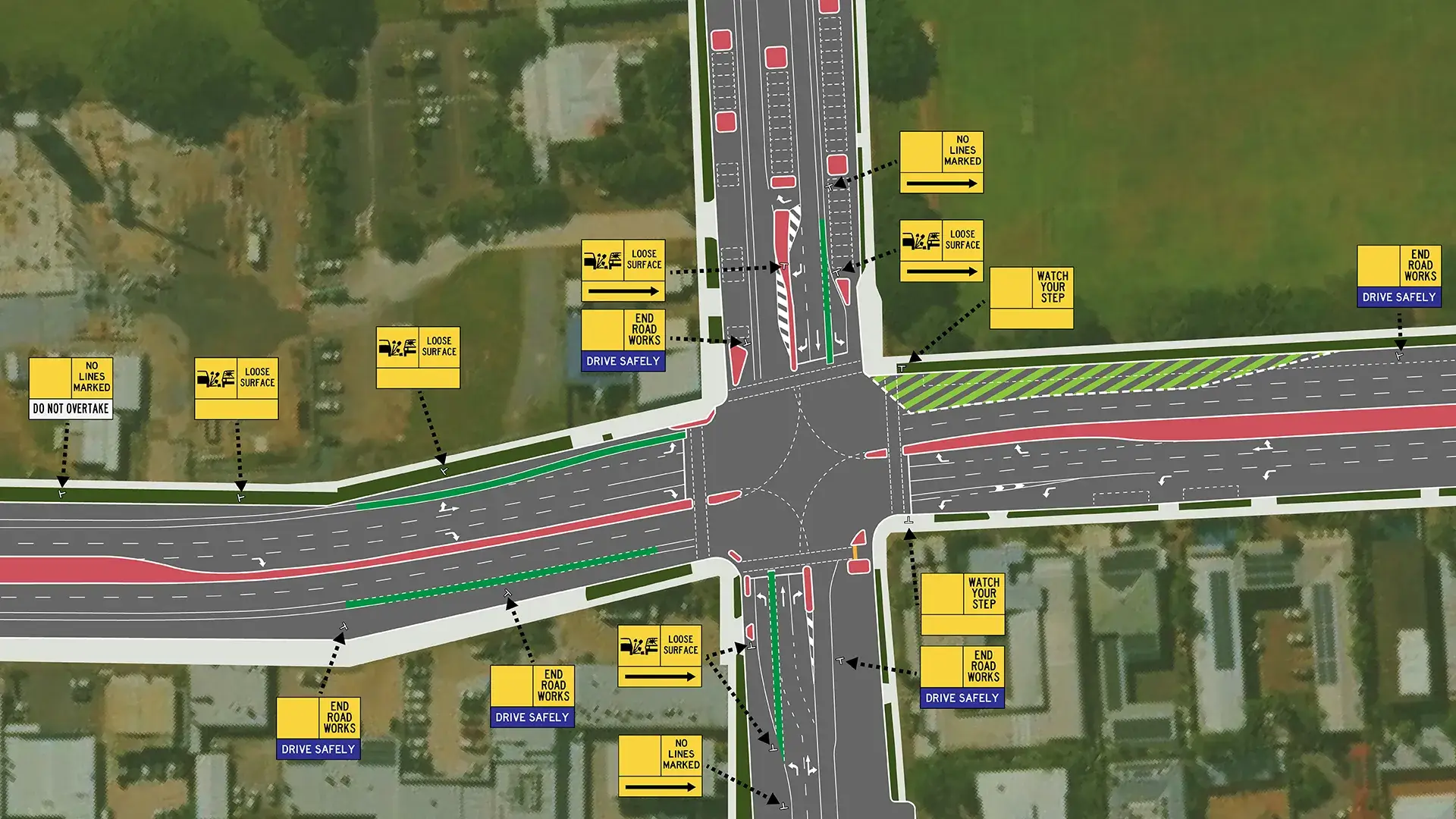
TGS drawings are often reviewed by TMR RoadTek or local council traffic engineers as part of the approval process.
When TMPs and TGS Are Required
You must submit a TMP and TGS for approval in Queensland whenever works:
- Involve lane closures, detours, or speed limit reductions on a state-controlled or council road Any works that restrict traffic flow, such as lane closures, full road closures, detours, or temporary speed reductions, must be supported by an approved Traffic Management Plan (TMP) and Traffic Guidance Scheme (TGS). These documents detail how traffic will be redirected safely, how signage will be installed, and how compliance with MUTCD Part 3 and local authority conditions will be maintained. Require traffic controllers or traffic control devices (signs, cones, barriers).
- Interfere with pedestrian or cyclist access
Where works affect footpaths, crossings, or cycle lanes, the TGS must clearly demonstrate safe alternative routes, temporary crossings, or diversions. The TMP outlines risk management strategies, including compliance with Disability Discrimination Act (DDA) accessibility requirements, to ensure vulnerable users are protected and disruptions minimised. - Extend beyond 8 hours or require multiple stages of traffic control
Long-duration projects or those staged over multiple days or phases requre a TMP that addresses fatigue management, staging sequences, and site handover processes. The TGS must show each stage of the works, ensuring traffic guidance remains consistent and safe as conditions evolve. This staged approach is critical for maintaining compliance throughout the project’s lifecycle. - Are part of high-risk works such as night works, major intersections, or high-volume road corridors High-risk environments demand a higher level of planning detail in both the TMP and TGS. For night works, this includes illumination requirements, advanced warning signage, and reduced speed environments. For major intersections or arterial roads, TGS layouts must address complex traffic movements and peak-hour volumes. The TMP ensures risk assessments, emergency procedures, and stakeholder coordination are in place to manage these challenging conditions.
Our Expertise in TMP and TGS Design
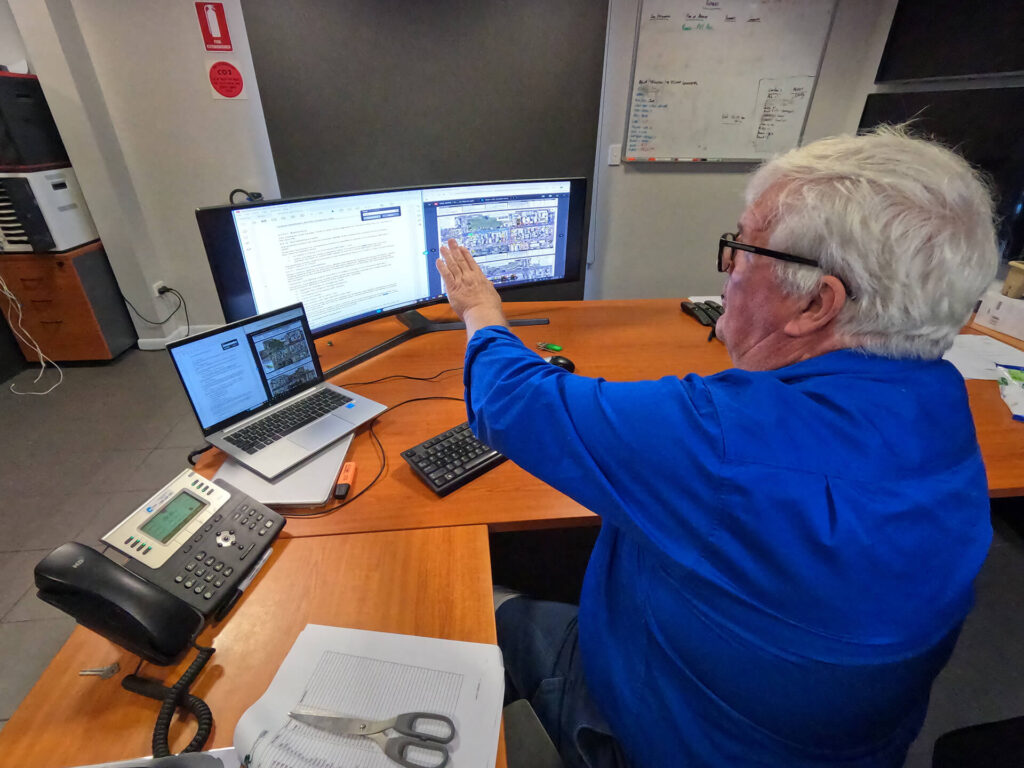
At Heritage Traffic Management, we deliver TMPs and TGS designs that meet Queensland TMR standards and ensure rapid council and authority approval. Our accredited Traffic Management Designers (TMDs) have extensive experience across civil construction, utilities, and event management.
We provide:
- Fully compliant TMP documentation with risk assessments.
- Detailed TGS drawings prepared to MUTCD Part 3 specifications.
- Fast turnaround for council and TMR approvals.
- End-to-end support, from planning through to on-site traffic control.
- Integration with insurance and WHS compliance requirements under Work Health and Safety Act 2011 (Qld).
Contact Us
Need a compliant Traffic Management Plan or TGS design in Queensland? Contact us today for expert guidance and fast approvals.
Phone: 1800 353 053
Email: sales@heritagetraffic.com.au
Website: heritagetraffic.com.au